Looking for something a little different to do this weekend? South Korea is full of interesting caves that are a great adventure to escape the rain or summer heat. South of Seoul challenges its readers to get out and explore the wonderful caves across Korea.
Our Experience Visiting Caves
We’ve enjoyed every cave we’ve visited in South Korea, even though we’re not really cave enthusiasts. Each cave we explored was so well-preserved that we finally understood why people rave about them. In the past, we’ve visited caves in other countries, but they were mostly filled with photos of what used to be there before everything got destroyed.
What to Know About Visiting Caves in Korea
Keep reading to learn some of the things we wished we knew before entering the cafes in South Korea:
Prepare for the Cold, Even in Summer
Korean caves, like most caves around the world, maintain a consistently cool temperature, even during the hot summer months. While it might be scorching outside, you can expect a temperature drop once you enter. It’s often a surprising shift, so it’s wise to bring a light sweater or jacket. This makes caves an ideal escape from the summer heat! Historically, Koreans have long recognized the cooling properties of caves, and they were often used as refuge spots during warmer months.
Wear Proper Footwear For Uneven Floors
Exploring caves in Korea can be an exciting adventure, but it’s important to wear sturdy, comfortable shoes. Korea does not perfectly smoothed out for your comfort, which can lead to slippery or rough terrain. Overlooking this can lead to discomfort, or worse, injury. Korean caves, especially those in areas like Jeju Island, often feature natural formations that haven’t been altered to make your walk easy, making good footwear essential.
Caves in Korea May Be Too Tight for Claustrophobic Visitors
No, really, they can be real tight. While caves are awe-inspiring, they can be intimidating for people with a fear of tight spaces. Some of Korea’s most popular caves, such as those in Jeju, feature narrow, winding passageways where visitors must crawl or squeeze through. This is part of the excitement for some, but it can be challenging for others. Historically, Koreans used caves as hideouts during times of invasion, such as the Japanese invasions of the late 16th century. This makes the experience of visiting even more thrilling but also adds to the potential discomfort.
Not all caves in Korea are open for unrestricted access. Some caves, especially those that are popular tourist spots, may require reservations. This is often due to space limitations and public health guidelines (especially relevant during the COVID-19 pandemic). We recommend planning ahead and booking tickets in advance, particularly during the peak tourist seasons.
Korean caves are famous for their natural beauty. From the expansive rooms filled with stalactites and stalagmites to underground rivers, Korea’s caves offer stunning views and unforgettable experiences. For example, the Manjanggul Cave on Jeju Island is one of the longest lava tubes in the world and showcases incredibly well-preserved volcanic formations. Many of these caves are still in pristine condition, unlike some caves in other countries, making them even more remarkable to visit.
Caves in Korea Have Interesting History
Korean caves have a rich historical significance. During various periods of conflict, including the Japanese invasions and the Korean War, Korean’s used as shelters or hideouts. Some caves were even used as military bases or places of refuge, providing protection from invading forces. Exploring these caves gives visitors a sense of Korea’s turbulent past, connecting them with the country’s historical resilience.
Themed Caves Exist Just for Fun
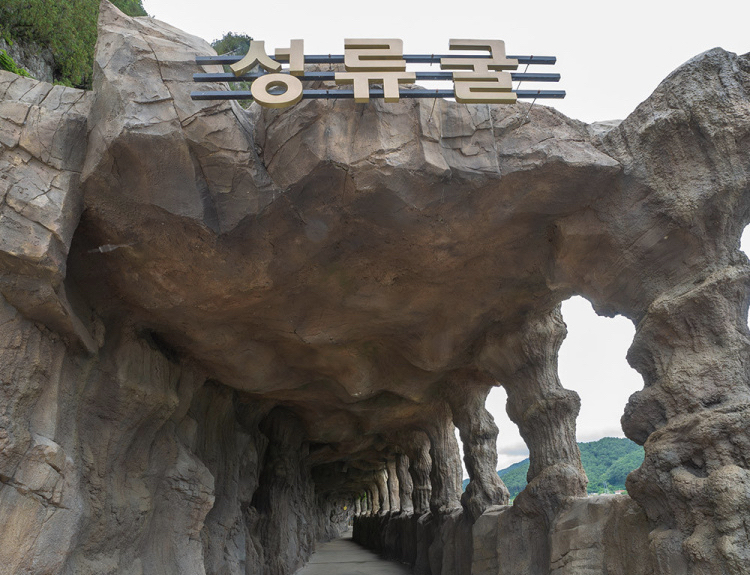
Not all caves in Korea are natural. That’s ok. Sometimes companies create artificial caves for leisure and entertainment. These caves often offer a cool, relaxing environment for visitors to escape the heat. Popular with tourists, some of these caves even feature wine bars, offering a unique experience where you can enjoy a glass of wine in a natural underground setting. These themed caves are a testament to the ongoing fascination with caves as both functional and recreational spaces in Korean culture.
Copy and paste phone numbers into Naver Maps to get directions
Hangul Name
용연동굴
Hangul Address
강원 태백시 태백로 283-29
Description
The cave is formed by limestone deposited in the Paleolithic Ordovis period are limestone caves that have been slowly dissolved in rainwater and groundwater over the past hundreds of years, and were designated as Gangwon-do Memorial No. 39 on February 26, 1980. Its total length is about 843 meters, and inside the cave is a large square with a width of 50 meters, a length of 130 meters and a height of 30 meters. The internal temperature of the cave is 9 to 11 degrees Celsius, and it is the only dry cave in Korea, with no underground water at the bottom of the cave, but there are 5-6 limpools. There are no underground water at the bottom of the cave, but there are five or six limpools. Lava and limestone are developed everywhere, and many characteristic cave animals are found due to their abundance of humidity and organic quality. It is the highest-level (980 m) cave known in South Korea to date, and is a large and complex three-dimensional old-age cave. Twenty-nine major cave animals have been discovered, and six species of cave animals with their burrows as their parent habitat have been listed.
Originally published
Written by
Lanae Rivers-Woods, MAIT
No formal audit has been recorded for this article under the current South of Seoul editorial process.
Historical article:
This article has not yet been formally audited under South of Seoul's current editorial process.
It remains available as part of our publishing history and may contain information that has changed since publication.
Before You Act
South of Seoul articles document information available at a particular point in time.
Prices, hours, services, policies, procedures, laws, eligibility requirements,
transportation, contact details, and local conditions can change.
Use this article as a research starting point and confirm important details using
current official resources, direct contact, Naver Maps, Kakao Map, and other reliable
sources when appropriate.
For consequential immigration, legal, medical, or financial decisions, confirm current
requirements with the relevant official authority or an appropriately qualified professional.
See something that needs updating?
Help us keep practical information useful.
Reader reports are reviewed by our editorial team
and do not automatically change this article.




 LeaDan Yee, M.Ed
 South of Seoul
 Angie Alvis, M. Ed
 Jetta Allen