Sports are more than games — they show who we are. In comparing Korea vs US sports culture, I’ve noticed that after watching American and Korean sports over the years, both countries share a love for athletic competition, but they express that love in completely different ways. From American tailgate parties to Korea’s perfectly synchronized baseball cheering, sports reveal each nation’s identity, values, and personality.
“Sports are a language everyone speaks, but each nation has its own accent.”
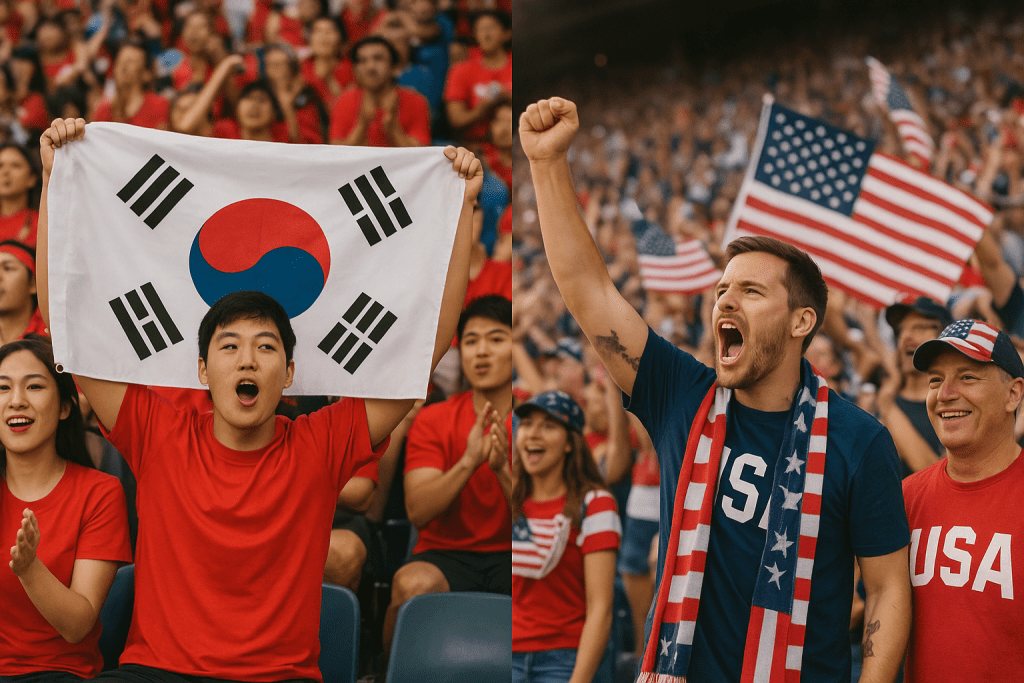
AI Generated Image
Fan Culture & Stadium Experience
United States: A Festival of Individual Spirit
American sports events feel like giant social celebrations. Fans arrive hours early to grill food, blast music, and enjoy tailgate parties with friends. Inside the stadium, cheering is loud and free — every fan shows emotion in their own style. Fireworks, halftime performances, marching bands, and mascots make the atmosphere feel like a community festival.
Korea: Organized Energy and Teamwork
In Korea, cheering is coordinated. Baseball games feel like a musical performance, with fans singing team songs, waving balloons, and following the lead of official cheerleaders. The entire crowd moves together, which gives Korean stadiums a special kind of unity.
While Americans celebrate individuality, Koreans celebrate harmony.
Fun Fact
Every KBO baseball team has official cheer leaders who guide the chants from start to finish!
Sports in Everyday Life & Schools
American Schools: Sports Are Part of Identity
In the U.S., school sports are a huge part of student life. Many students join teams, wear jerseys proudly, and dream of NCAA scholarships. Sports help students build leadership, confidence, and school spirit — both on and off the field.
Korean Schools: Academics First, but Change Is Coming
Traditionally, Korean students focused heavily on academics. However, this is starting to shift. More schools now offer after-school sports clubs, student sports festivals, and PE programs that encourage participation for everyone. Students learn teamwork, discipline, and the joy of physical activity — even if they aren’t top athletes.
Did You Know?
The NCAA (National Collegiate Athletic Association) manages over 500,000 student-athletes across the U.S. — making it the largest college sports organization in the world!
Sports and National Identity
United States: Heroes of Individual Greatness
In the U.S., athletes like Michael Jordan, Serena Williams, and Tom Brady represent personal excellence and the idea that anyone can achieve greatness through hard work. Events like the Super Bowl or NBA Finals bring the entire country together to celebrate ambition and individual talent.
Korea: Victory as a Shared Achievement
In Korea, sports victories often feel like national victories. During the 2002 World Cup, millions of people filled the streets in red shirts, chanting “Dae~han Min-guk!” An athlete’s success becomes a moment of unity and national pride.
Cultural Insight
Koreans often call successful athletes “heroes of the people,” showing how deeply sports are linked to national emotion and identity.
Sports Foreigners Can Enjoy in Korea
(Especially helpful for U.S. military families, teachers, and international residents)
If you’re living in Korea, experiencing local sports is a great way to connect with the culture.
Join the fun at a Korean baseball stadium — sing along, follow the chants, and enjoy fried chicken in the stands. Teams near Pyeongtaek include the KT Wiz (Suwon) and LG Twins / Doosan Bears (Seoul).
Korea hosts community races year-round. These events welcome all ages and are a fun way to stay active together.
Final Thoughts
Both the United States and Korea love sports, but they show that love differently. Americans focus on freedom and individuality. Koreans focus on harmony and unity. Yet both countries understand the deeper meaning of sports — bringing people together beyond borders.
As a Korean student dreaming of becoming a physical education teacher, I hope to combine the American passion for play with the Korean spirit of togetherness. Because in the end, sports aren’t just about winning — they’re about growing, connecting, and becoming stronger together.
About the “Shared Voices” Initiative
South of Seoul volunteers collaborate with Korean public schools to provide students meaningful opportunities to expand their English communication experience while sharing their world views with the international community in Korea.
Through guided projects, students in Korean classrooms use digital and creative tools to express themselves in English, building confidence in their communication skills. At the same time, they learn to approach writing with empathy. They participate in guided discussions that consider different perspectives, practicing cultural awareness, and developing a deeper understanding of how their words can connect communities across borders.
It’s important to know that schools in South Korea are becoming increasingly diverse, this includes the students who participate in South of Seoul programs like “Shared Voices.”
SOUTH OF SEOUL EDITORIAL INFORMATION
Article Information & History
Historical Record
Originally written byEunseon Jeong
Originally publishedNovember 21, 2025
Article History
Originally published
Written by
Eunseon Jeong
No formal audit has been recorded for this article under the current South of Seoul editorial process.
Historical article:
This article has not yet been formally audited under South of Seoul's current editorial process.
It remains available as part of our publishing history and may contain information that has changed since publication.
Before You Act
South of Seoul articles document information available at a particular point in time.
Prices, hours, services, policies, procedures, laws, eligibility requirements,
transportation, contact details, and local conditions can change.
Use this article as a research starting point and confirm important details using
current official resources, direct contact, Naver Maps, Kakao Map, and other reliable
sources when appropriate.
For consequential immigration, legal, medical, or financial decisions, confirm current
requirements with the relevant official authority or an appropriately qualified professional.
See something that needs updating?
Help us keep practical information useful.
Reader reports are reviewed by our editorial team
and do not automatically change this article.



 Jetta Allen

 South of Seoul

 KimchiRednecks