ContentsView article sections
Did you just move to South Korea and feel confused about why everyone makes such a big deal about your Digital Identity Verification through your smartphone? Does it seem like something you don’t really need to learn about? Let’s explore it what the system is and what it may help you with.
About South Korean Digital Connectivity
Living in South Korea means learning to navigate a highly interconnected digital society. From managing your health insurance and accessing government documents to ordering groceries, making restaurant reservations, and managing your finances, many aspects of daily life rely on digital identity verification. The digital system allows you to manage much of your life in a few clicks.
South Korea operates a formal identity verification system that connects individuals’ legal identities with a wide range of digital services. One of the most commonly used methods of accessing this system is through a registered Korean mobile phone number.
Setting Up Your Digital Identity Matters
However, one of the things international residents may not realize when they first move to Korea is that having a Korean cell phone number and having a Korean cell phone number linked to their legal identity are two very different things. They think that any old smartphone will do and don’t make the effort to set up their digital identity correctly from the start.
Without this functionality, international residents may find themselves unintentionally excluded from parts of Korean society, even when they have been living, working, and paying taxes in Korea for years. Don’t let that be you. Understand the importance of the system from the start.
What Is Korea’s Digital Identity Verification System (본인확인제도)?
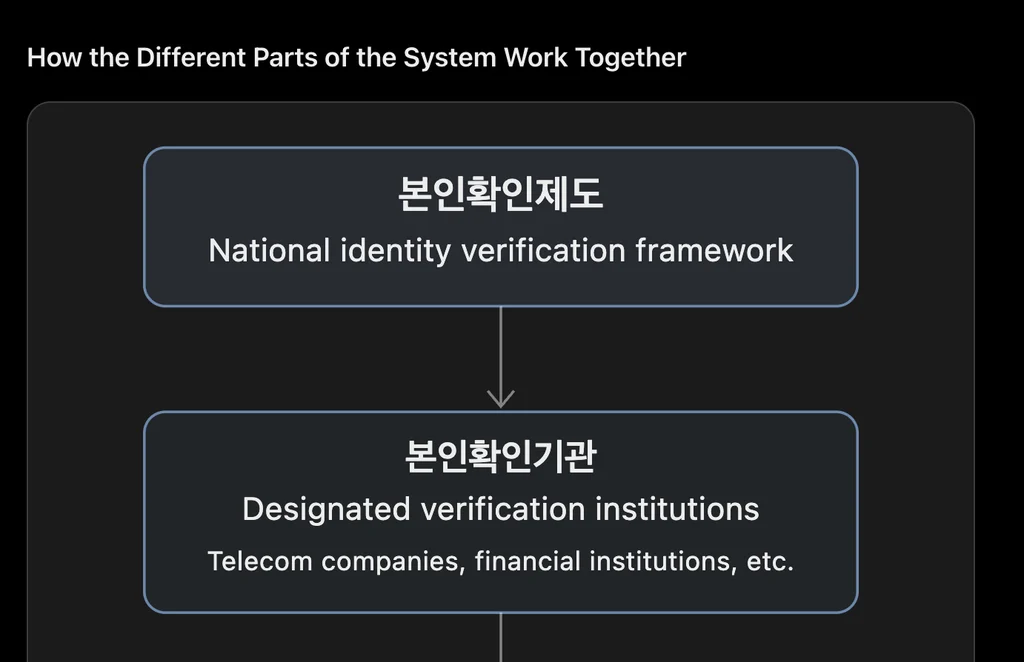
South Korea operates a national identity verification framework called the 본인확인제도 (Identity Verification System). This framework allows businesses, government agencies, financial institutions, and digital platforms to electronically verify an individual’s legal identity without directly collecting their resident registration number or foreign registration number.
Under this framework, designated organizations known as 본인확인기관 (Identity Verification Institutions) provide identity verification services to other organizations. The Korea Internet & Security Agency (KISA, 한국인터넷진흥원) provides technical and administrative support for the system.
Korea’s identity verification framework supports several verification methods:
- Mobile phone verification (휴대폰)
- Credit card verification (신용카드)
- Internet personal identification number (아이핀)
- Digital certificates (인증서)
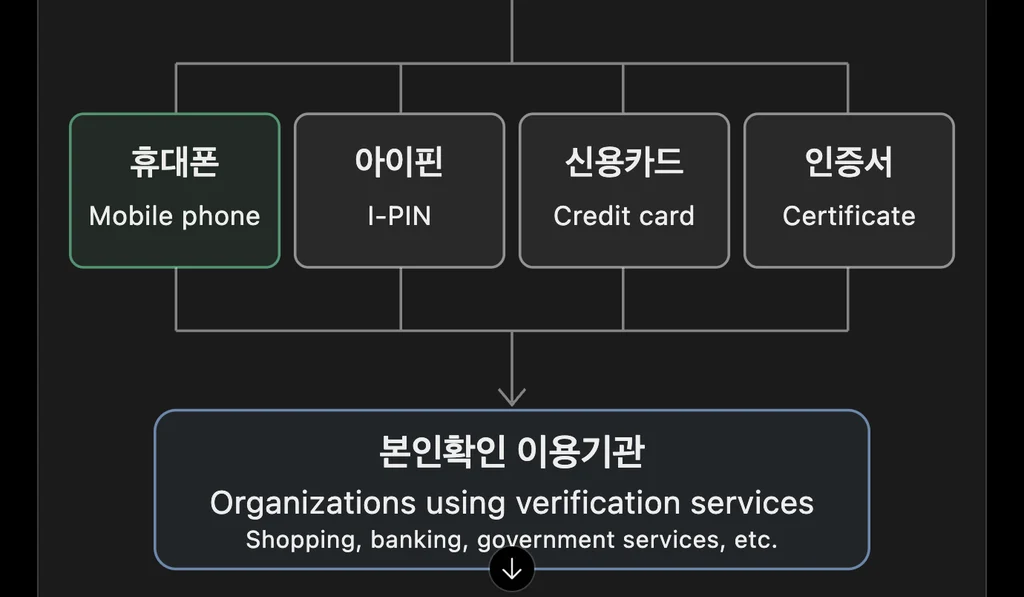
One of the most commonly encountered methods in everyday life is 휴대폰 본인확인서비스 (Mobile Phone Identity Verification Service), commonly referred to as 휴대폰 본인인증.
When you attempt to register for a Korean website or application using this method, the business requests identity verification through a designated provider. The provider uses the legal identity associated with your mobile phone subscription to verify who you are and returns the verification results to the business.
This interconnected system is why having a Korean mobile phone registered under your own legal identity is so important when living in South Korea. Your mobile phone subscription effectively becomes a gateway to accessing many of Korea’s public and private digital services.
Official resource: Korea Internet & Security Agency – Identity Verification Support Portal (본인확인 지원포털)
Important Korean Digital Identity Terminology
Before we dig deeper, let’s introduce some terms. Understanding the following terminology may help international residents navigate Korean websites, mobile applications, and conversations with customer service representatives. These words might help you if you ever need to troubleshoot issues with your digital identity. We are putting these here to help folks who are searching online for help.
| Korean | English |
|---|---|
| 본인확인제도 | Identity Verification System |
| 본인확인서비스 | Identity Verification Service |
| 휴대폰 본인확인서비스 | Mobile Phone Identity Verification Service |
| 휴대폰 본인인증 | Mobile Phone Identity Authentication |
| 본인확인기관 | Identity Verification Institution |
| 본인명의 휴대폰 | Mobile Phone Registered in One’s Own Name |
| 실명인증 | Real-Name Authentication |
| 디지털 신원 | Digital Identity |
| 간편인증 | Simplified Authentication |
| 연계정보 (CI) | Connecting Information |
| 중복가입 방지정보 (DI) | Duplicate Registration Prevention Information |
| 모바일 신분증 | Mobile Identification Card |
Although these terms are related, they do not all refer to the same process or technology. They need to be here to help you understand aspects of the system, now let’s jump back into talking about how the system works.
Official resource: KISA Identity Verification Support Portal (본인확인 지원포털)
How Is Korea’s Mobile Phone Identity Verification Different?
International residents may initially assume that Korean cell phone identity verification works the same way as text message verification in their home countries. However, there is an important distinction.
Ordinary SMS verification typically confirms that someone has access to a particular phone number. Korea’s mobile phone identity verification service can also verify the legal identity of the individual associated with that phone number. The graphic below separates it out:
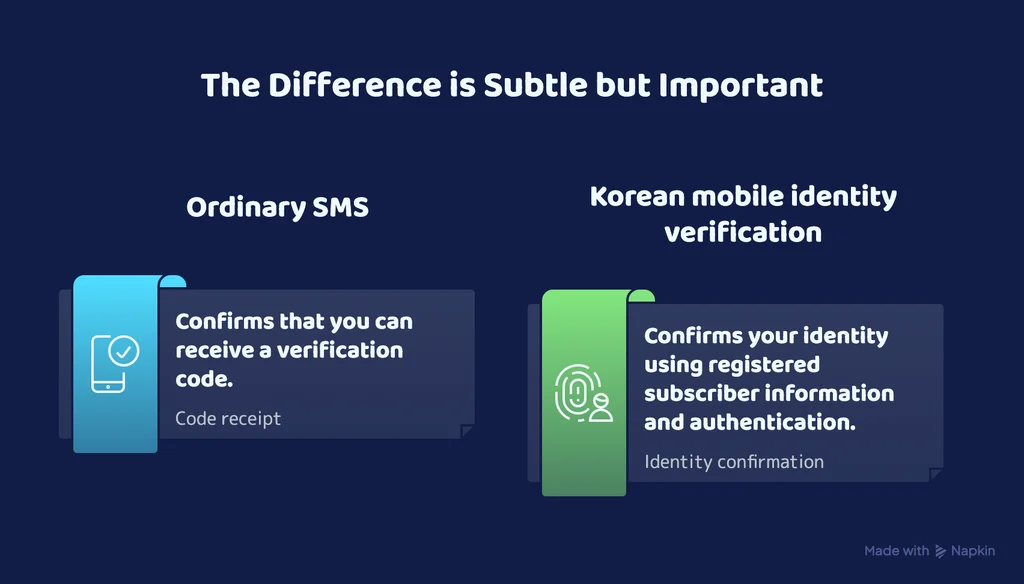
This means that a Korean website may be able to confirm that you are a particular registered individual, rather than simply confirming that you have a working mobile phone number.
Of course, Korea also uses ordinary SMS verification, and other countries have their own digital identity systems. The distinction is between verifying possession of a phone number and verifying a person’s legal identity.
How Does Korea’s Digital Identity Verification Infrastructure Work?
When an international resident registers an eligible mobile phone subscription under their legal identity, the telecommunications provider maintains identifying information associated with that subscription.
This may include:
- Legal name (성명), which MUST EXACTLY match the name on the passport or ID card they entered Korea with; this matters for some U.S. military-affiliated people and some foreign diplomats.
- Foreign registration number (외국인등록번호)
- Date of birth (생년월일)
- Mobile phone number (휴대전화번호)
- Mobile service provider (통신사)
- Applicable residency identification information
When an individual uses mobile phone identity verification, the identity verification provider checks the relevant information and authenticates the individual. The participating website or application can then receive verification results and, where applicable, digital identifiers that allow it to recognize the individual.
Understanding CI and DI: Korea’s Digital Identity Identifiers
Two important components of Korea’s identity verification infrastructure are CI and DI.
Connecting Information (연계정보 or CI) is an identifier that can allow participating services to recognize the same individual across different systems, where authorized.
Duplicate Registration Prevention Information (중복가입 방지정보 or DI) is an identifier that helps an individual service recognize a user and prevent duplicate registrations.
These identifiers help reduce the need for individual websites to collect and store sensitive registration numbers directly. They also help explain why Korea’s digital identity verification infrastructure is about more than simply receiving a text message.
However, this does not mean that every participating business automatically has access to your immigration records, medical history, financial information, or other personal data. Your privacy does matter. Identity verification and authorization to access personal records are separate processes. This is a very important aspect of the system
Official resource: KISA Digital Identity Verification Definitions
Having a Korean Phone Number Does Not Guarantee Digital Identity Access
One of the most important things international residents need to understand when purchasing a mobile phone plan is that not every Korean phone subscription provides access to mobile identity verification.
| Type of mobile phone registration | Can make calls and receive texts | Mobile identity verification |
|---|---|---|
| Residence card-linked postpaid plan | Yes | Generally yes, if supported |
| Phone registered to an employer | Usually | Not under your own identity |
| Phone registered to a spouse or friend | Usually | Not under your own identity |
| Passport-only SIM card | Depends on plan | Generally unavailable |
| Residence card-linked prepaid plan | Usually | Depends on provider and plan |
| Budget mobile phone plan (알뜰폰) | Usually | Depends on provider and registration |
| Data-only SIM or eSIM | Generally no | Generally unavailable |
The important distinction is not necessarily whether you purchase a prepaid plan, a postpaid plan, or an affordable mobile phone plan.
What matters is whether the subscription supports 휴대폰 본인확인서비스 and is correctly registered under your own legal identity.
You do not necessarily need an expensive mobile phone plan to participate in Korea’s digital society.
What Services Are Connected to Korea’s Digital Identity Verification System?
The impact of not having access to mobile phone identity verification extends well beyond communication. It can affect your ability to live independently, manage your household, participate in your community, and exercise your rights as a resident of South Korea.
Although authentication requirements vary by platform, the following areas of daily life frequently involve digital identity verification.
1. Banking and Financial Services (은행 및 금융 서비스)
Korea’s financial infrastructure relies heavily on digital identity verification. Even if you successfully open a bank account in person, you may experience difficulties accessing additional financial services online.
Services that may involve digital identity verification include:
- Mobile and internet banking
- Opening additional bank accounts
- Registering for debit and credit cards
- Applying for loans
- International money transfers
- Registering for investment services
- Accessing credit scores
- Managing retirement accounts
- Purchasing insurance
- Recovering banking passwords
- Issuing digital authentication certificates
Without access to identity verification, you may need to visit your bank in person more frequently or find yourself unable to access certain financial products. Sometimes, services may only exist online.
However, South Korea has been working to improve digital financial access for international residents. In September 2023, the Ministry of Justice introduced a residence card verification service for financial institutions. In March 2025, participating banks began accepting mobile foreign resident cards for financial transactions.
Official resource: Financial Services Commission (금융위원회)
2. Government and Immigration Services (정부 및 출입국 서비스)
International residents may encounter digital identity verification requirements when accessing government services through the following platforms.
| Platform | Purpose |
|---|---|
| Government24 (정부24) | Government documents and administrative services |
| Hi Korea (하이코리아) | Immigration-related services |
| HomeTax (홈택스) | Tax filing and documentation |
| Wetax (위택스) | Local taxes |
| National Pension Service (국민연금) | Pension contributions and records |
| Safety e-Report (안전신문고) | Reporting public safety issues |
| e-People (국민신문고) | Government complaints and civil petitions |
Depending on the platform, digital identity verification may help residents download official documents, check tax payments, submit administrative applications, review pension contributions, and file complaints with government agencies.
Without access to digital identity verification or an accepted alternative, international residents may spend considerably more time visiting administrative offices and gathering documents in person. This can be particularly challenging for residents who work full-time or live in rural areas.
3. Healthcare and National Health Insurance (의료 및 국민건강보험)
Access to Korea’s digital healthcare infrastructure can make managing your health significantly easier. Especially now that your ID or National Health Insurance app is required for every medical visit.
Services that may involve digital identity verification include:
- National Health Insurance Service (NHIS) online services
- Mobile health insurance cards (모바일 건강보험증)
- National health screening results
- Health insurance contribution records
- Hospital appointment applications
- Digital medical records
- Private health insurance claims
- Prescription history services
- Telemedicine applications
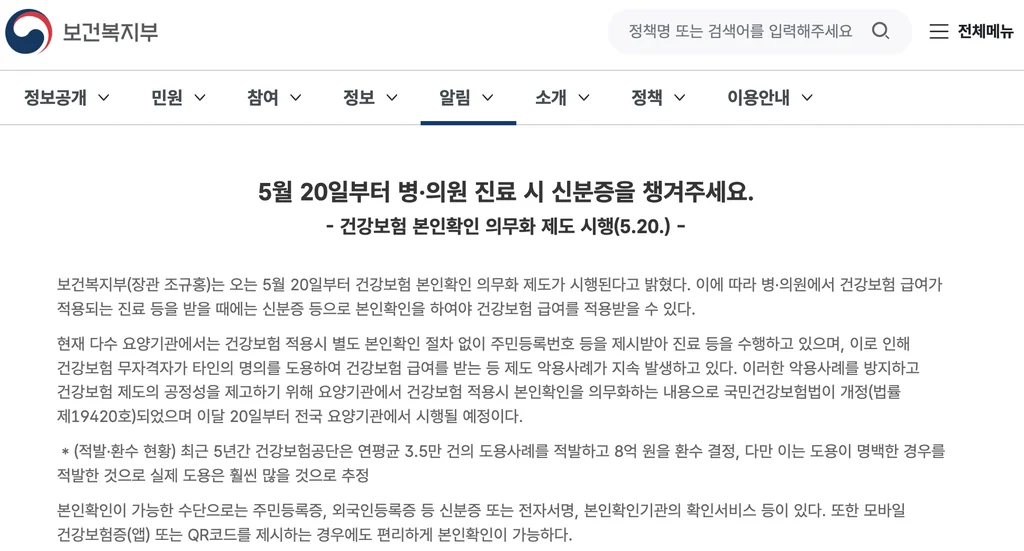
International residents without access to digital identity verification may have more difficulty independently reviewing their healthcare information or managing appointments and insurance claims. This can be particularly challenging for residents managing chronic health conditions, caring for aging family members, or raising children in Korea.
Important: Not having access to mobile identity verification does not mean you are ineligible for National Health Insurance or cannot receive medical treatment. Physical identification and other administrative options remain available.
Official resources:
- National Health Insurance Service (국민건강보험공단)
- Health Insurance Review & Assessment Service (건강보험심사평가원)
4. Online Shopping and Food Delivery (온라인 쇼핑 및 배달)
Of course, food delivery access might exist as the most compelling reason to have your digital identity in order. Many Korean e-commerce platforms incorporate identity verification into account registration, payment authentication, account recovery, or specific purchasing functions. Examples of platforms where residents may encounter verification requirements include:
- Coupang (쿠팡)
- Gmarket (지마켓)
- 11st (11번가)
- Naver Shopping (네이버쇼핑)
- Market Kurly (마켓컬리)
- Baemin (배달의민족)
- Yogiyo (요기요)
- Coupang Eats (쿠팡이츠)
Although some platforms offer limited access or alternative payment options, international residents without digital identity verification may find themselves unable to access the same services, discounts, memberships, or payment options as other residents.
This can also impact household expenses by limiting access to competitively priced online products.
Being unable to shop online easily is particularly problematic for people living in rural Korea, where local shopping options may be limited.
5. Digital Payments and Electronic Wallets (간편결제 및 전자지갑)
Digital payment systems are increasingly integrated into everyday transactions in South Korea.
- Kakao Pay (카카오페이) – Digital payments, money transfers, and financial services.
- Naver Pay (네이버페이) – Online shopping, payments, and rewards.
- Toss (토스) – Money transfers, financial management, and banking services.
- Samsung Wallet (삼성월렛)– Mobile payments and digital wallet services.
Without digital identity verification, international residents may experience difficulties connecting bank accounts, registering payment cards, transferring money, or participating in rewards programs.
You might also miss out on rewards and discounts. Over time, exclusion from these systems may also mean missing out on consumer benefits available to other residents, and it may feel frustrating eventually.
6. Transportation and Mobility (교통 및 이동 서비스)
While many basic transportation services remain accessible without identity verification, some advanced features and membership services may require it.
Examples include:
- Car-sharing services
- Rental car applications
- Public bicycle rental programs
- Mobile transportation cards
- Taxi application payment systems
- Electric vehicle charging memberships
- Transportation reimbursement programs
- Parking applications
- Transportation subscription plans
For international residents living outside major metropolitan areas, restricted access to transportation applications may further limit their mobility and independence.
7. Employment and Labor Services (고용 및 노동 서비스)
Digital identity verification may also be necessary when accessing information related to employment and labor.
This may include:
- Employment insurance records
- Unemployment benefit applications
- Government-funded vocational training
- Employment support programs
- Employment-related tax documents
- Online labor complaints
- Professional certification applications
- Workplace retirement accounts
International residents may encounter these requirements through platforms such as Employment24 (고용24) and the Ministry of Employment and Labor (고용노동부).
Having difficulty verifying your identity does not necessarily mean you are ineligible for employment-related benefits. However, it may complicate the process of accessing them.
8. Housing and Household Management (주거 및 생활 관리)
Digital identity verification may also impact your ability to independently manage your home.
Examples include:
- Managing electricity bills
- Managing gas bills
- Applying for home internet services
- Managing telecommunications contracts
- Accessing apartment management applications
- Using electronic rental contracts
- Managing household insurance
- Accessing certain real estate documents
International residents who rely on employers, landlords, or Korean spouses to establish these services may experience additional complications when changing jobs, moving homes, or experiencing changes in family circumstances.
9. Education and Family Services (교육 및 가족 서비스)
International residents raising children in South Korea may encounter digital identity verification requirements when navigating educational and family-related services.
These may include:
- School parent communication applications
- Childcare registration
- Kindergarten enrollment
- Government childcare assistance programs
- After-school program registration
- Educational records
- Parent portals
- Child-related healthcare services
- Local family support programs
Difficulties accessing these platforms may place additional administrative responsibilities on one parent and limit another parent’s ability to independently manage their child’s education and care.
10. Community Participation and Everyday Life (지역사회 및 일상생활)
Some of the less obvious impacts of digital identity verification involve participation in local communities.
International residents may encounter verification requirements when trying to access:
- Karrot (당근) secondhand shopping and community services
- Local government recreation programs
- Public sports facilities
- Community center classes
- Library memberships and digital library services
- Concert and event ticketing
- Restaurant reservation platforms
- Membership rewards programs
- Online community forums
- Age-restricted online content
Individually, these restrictions may seem relatively insignificant. Collectively, however, they can affect how easily international residents develop social networks, participate in local activities, and feel connected to their communities.
11. International Shipping and Customs (해외직구 및 통관)
International residents who purchase products from overseas may need a Personal Customs Clearance Code (개인통관고유부호), commonly referred to as a PCCC.
Obtaining and managing this code online involves identity verification.
Additionally, beginning in 2026, newly issued personal customs clearance codes are subject to an annual renewal requirement. Codes issued before 2026 have their initial expiration dates set according to the holder’s birthday in 2027. This makes maintaining access to identity verification particularly important for residents who regularly purchase products from overseas. Korea Customs Service+1
Official resource: Korea Customs Service – Personal Customs Clearance Code
What Happens When You Don’t Have Digital Identity Verification in Korea?
The impact of digital exclusion can accumulate over time.
| Area of life | Potential impact |
|---|---|
| Financial independence | Limited access to financial products and payment options |
| Healthcare | Difficulty independently managing health information |
| Employment | Additional barriers to accessing labor services |
| Government | More in-person administrative visits |
| Social integration | Reduced participation in community activities |
| Household expenses | Limited access to discounts and online shopping |
| Transportation | Fewer mobility options |
| Parenting | Challenges independently managing children’s services |
| Personal independence | Increased reliance on other people |
| Consumer rights | Difficulty managing accounts and complaints |
| Administrative responsibilities | Increased time and travel expenses |
For someone visiting Korea for several weeks, these limitations may amount to minor inconveniences. For someone living in Korea for five, ten, or twenty years, they can become significant structural barriers. International residents may even find themselves paying more for goods and services because they cannot access the same digital infrastructure as other residents.
Access to mobile identity verification should therefore be understood as an important part of settling into life in South Korea. Don’t be the reason you are socially excluded.
Why International Residents Experience Difficulties With Digital Identity Verification
Even international residents who have valid residence cards and Korean mobile phone numbers may experience problems completing identity verification.
1. Inconsistent Name Formatting
Korean digital systems do not always accommodate international names well.
Common issues include:
- Middle names
- Hyphenated names
- Spaces between names
- First and last name order
- Capitalization
- Names exceeding character limits
- Differences between English and Korean names
- Different Romanization of names
Your name may be registered differently with immigration, your bank, your telecommunications provider, and other institutions. These inconsistencies can cause authentication failures.
If you are experiencing repeated identity verification failures, one of the first things we recommend doing is checking exactly how your telecommunications provider has registered your name.
2. Your Phone Is Registered in Someone Else’s Name
Some international residents have their mobile phone contracts established by their Korean spouse, employer, Korean friend, recruitment agency, or family member.
Although this may initially make setting up life in Korea easier, it can create considerable problems later.
You have access to the phone number, but you do not have control over the legal identity associated with that number.
Additionally, using that phone number to complete legal identity verification may authenticate the registered owner of the phone rather than you.
This can become particularly problematic when changing employers, getting divorced, leaving a relationship, or experiencing a disagreement with the person who owns the contract.
3. Your Phone Was Registered Using Your Passport
Some international residents establish mobile phone service before receiving their residence cards.
However, receiving your residence card does not necessarily mean your telecommunications provider automatically updates your account information.
You may need to contact your provider to update your registration or change your mobile phone plan before accessing 휴대폰 본인확인서비스.
4. Your Mobile Phone Plan Does Not Support Identity Verification
Not all mobile phone plans offer the same functionality.
When purchasing a budget mobile phone plan (알뜰폰), prepaid phone plan (선불폰), or eSIM, international residents should confirm that the specific plan supports identity verification.
However, do not assume that budget mobile phone providers cannot provide access to Korea’s digital identity verification system. For example, KT M Mobile specifically states that international residents can use its identity verification services. kt M모바일 공식 다이렉트몰
5. Your Immigration Information Has Changed
International residents may encounter authentication problems after changes to their personal or immigration information.
These may include:
- Renewing their residence cards
- Changing their legal names
- Changing their visa status
- Receiving permanent residency
- Becoming naturalized Korean citizens
- Changing their mobile service providers
Depending on the circumstances, residents may need to update their personal information with multiple institutions.
6. The Website Does Not Properly Support International Residents
Sometimes the problem is not with your mobile phone or legal identity.
An individual website or application may not have been designed to accommodate international residents.
Potential problems include:
- Registration forms that only accommodate Korean citizens
- Name fields with restrictive character limits
- Authentication systems that do not properly recognize foreign registration numbers
- Services that do not recognize certain types of residence identification
- Restrictions imposed by the business or service provider
Successfully completing mobile identity verification does not automatically guarantee access to every Korean digital service.
Why You Should Avoid Registering Your Phone in Someone Else’s Name
At South of Seoul, we encourage international residents to establish as much of their administrative and financial lives as possible under their own legal identities.
This includes mobile phone contracts.
Registering a mobile phone under someone else’s name may seem like a convenient short-term solution, but it can create long-term issues related to:
- Financial independence
- Personal privacy
- Account ownership
- Identity theft
- Consumer protection
- Domestic abuse and financial control
- Employment dependency
- Account and password recovery
- Ownership of online memberships and digital accounts
You should also be cautious of mobile phone retailers who offer to register your phone under another person’s name as a way of bypassing international resident registration requirements. Such arrangements may expose you to fraudulent activity and possible legal complications.
A cheap phone plan that limits your ability to independently participate in Korean society may ultimately cost you more.
Is Mobile Phone Verification the Only Way to Access Korea’s Digital Identity System?
Theorectically, No. The mobile phone identity verification service is one component of Korea’s broader identity verification infrastructure. However, sometimes you need the digital identity to make the other verification systems work. So you can use your credit card to verify your identity, but you need your Digital Identity to verify the credit card.
That said, KISA identifies four general categories of identity verification alternatives to directly using resident registration numbers.
- Mobile phone (휴대폰) – Identity verification using a registered mobile phone subscription.
- I-PIN (아이핀) – An internet personal identification system that provides an alternative to directly using registration numbers online.
- Credit card (신용카드) – Identity verification through eligible credit card services.
- Digital certificate (인증서) – Electronic credentials used to authenticate an individual’s identity.
Not every website accepts every verification method, and not every method is equally accessible to international residents.
Additional Digital Authentication Tools
International residents may also encounter the following digital authentication tools when navigating life in Korea.
| Korean | English | Common uses |
|---|---|---|
| 공동인증서 | Joint Digital Certificate | Banking and administrative services |
| 금융인증서 | Financial Certificate | Financial and administrative services |
| 간편인증 | Simplified Authentication | Authentication through participating applications |
| 카카오 인증서 | Kakao Certificate | Participating public and private services |
| 네이버 인증서 | Naver Certificate | Participating public and private services |
| PASS 인증서 | PASS Certificate | Participating online services |
| 모바일 신분증 | Mobile ID | Government-issued digital identification |
| 모바일 외국인등록증 | Mobile Foreign Resident Card | Digital residence identification |
Although some of these services may provide alternatives to mobile phone identity verification, their initial registration processes may also require digital mobile authentication. So you can’t get them without the digital system established.
This creates a frustrating situation for some international residents: they need digital identity verification to register for tools that provide digital identity verification.
Korea’s Mobile Foreign Resident Card (모바일 외국인등록증)
This became even more entertwined on January 10, 2025, South Korea introduced mobile residence cards for registered international residents. The mobile identification system includes digital versions of the following residence identification cards:
- Foreign Resident Card (외국인등록증)
- Permanent Resident Card (영주증)
- Overseas Korean Resident Card (국내거소신고증)
Unlike traditional mobile phone identity verification, these are government-issued digital identification documents.
Mobile Identity Verification vs. Mobile Residence Cards
| Mobile Phone Identity Verification | Mobile Residence Card | |
|---|---|---|
| Korean name | 휴대폰 본인확인서비스 | 모바일 외국인등록증 |
| Type | Identity verification service | Government-issued digital ID |
| Provided by | Designated identity verification providers | Government |
| Primary purpose | Electronic identity authentication | Proof of legal identity |
| Online use | Yes | Where supported |
| In-person use | Where supported | Where accepted |
| Replaces physical ID | Not generally | Where officially accepted |
These systems serve different purposes. Having one does not necessarily eliminate the need for the other. We recommend that eligible international residents familiarize themselves with both systems.
Official resource: Korean Government Mobile ID Website
Protecting Your Digital Identity in South Korea
Since mobile phone subscriptions are closely connected to digital identity verification, international residents should take steps to protect their telecommunications accounts and personal information.
Msafer: Identity Theft Prevention Service (명의도용방지서비스)
Of course, you need to know how to manage your digital identity and make sure it’s all in order. Msafer is a free telecommunications identity theft prevention service that helps individuals monitor subscriptions registered under their legal identities. Msafer provides services that allow eligible users to:
- Check telecommunications subscriptions registered under their names.
- Restrict unauthorized new subscriptions.
- Receive notifications regarding new telecommunications contracts.
- Identify potentially fraudulent subscriptions.
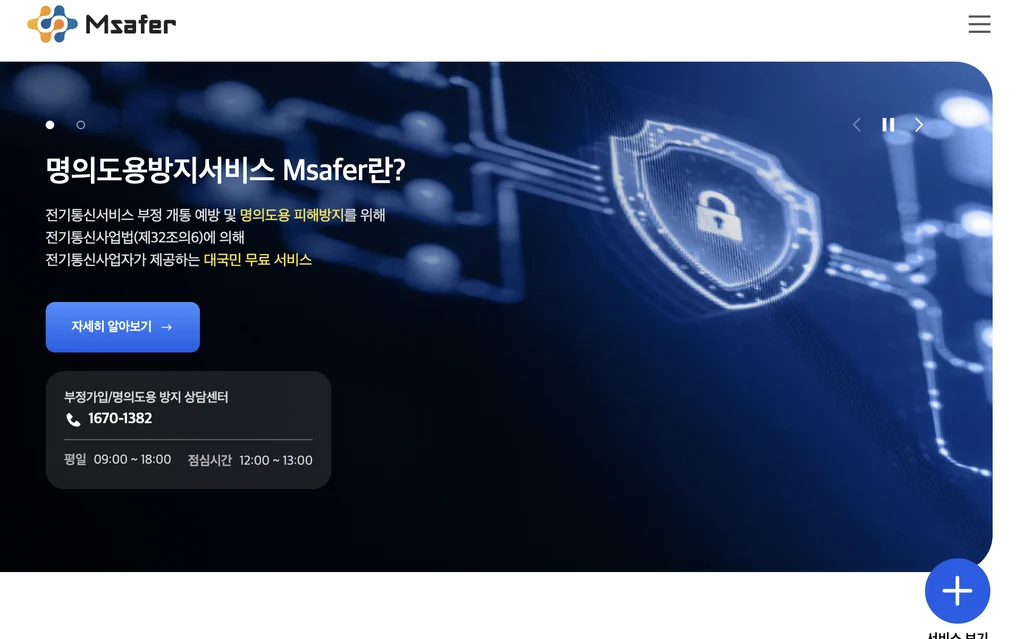
We recommend reviewing your telecommunications accounts, particularly if you have previously provided copies of your passport or residence card to mobile phone retailers.
Official website: Msafer
Reviewing Your Identity Verification History (본인확인 내역 조회)
South Korea’s Personal Information Portal (개인정보 포털) also offers services that allow eligible users to review their identity verification history.
These services may help individuals identify websites where identity verification has occurred and request withdrawal from certain unwanted website memberships. 개인정보 포털+1
Official website: Personal Information Portal
Other Ways to Protect Your Digital Identity
- Never share identity verification codes with other people.
- Do not approve unexpected PASS authentication requests.
- Do not allow other people to register phone numbers under your name.
- Verify telecommunications retailers before providing identification documents.
- Update your account recovery information before changing phone numbers.
- Report suspected unauthorized subscriptions immediately.
- Be cautious about links sent through unsolicited text messages.
Your mobile phone account should be treated with the same level of care as your banking information and other sensitive personal documents.
Useful Korean Phrases for Digital Identity Verification
You may find the following phrases helpful when visiting a Korean mobile phone retailer or contacting customer service.
| English | Korean |
|---|---|
| Is this phone registered in my name? | 이 휴대폰은 제 명의로 등록되어 있나요? |
| Does this plan support identity verification? | 이 요금제는 휴대폰 본인 인증이 가능한가요? |
| Can foreigners use identity verification with this plan? | 외국인도 이 요금제로 본인 인증을 할 수 있나요? |
| Is my foreign registration number registered? | 제 외국인등록번호가 등록되어 있나요? |
| Please check how my name is registered. | 제 이름이 어떻게 등록되어 있는지 확인해 주세요. |
| My identity verification keeps failing. | 계속 본인 인증에 실패해요. |
| I want to register the phone in my own name. | 제 명의로 휴대폰을 개통하고 싶어요. |
| I want to update my registration information. | 가입자 정보를 변경하고 싶어요. |
| Is there another way to verify my identity? | 다른 본인 인증 방법이 있나요? |
| I think someone has used my identity without permission. | 제 명의가 도용된 것 같아요. |
Digital Accessibility Is an Immigration and Integration Issue
Discussions about international residents in South Korea often focus on language barriers and cultural differences. However, access to digital infrastructure deserves equal attention. Many of the issues related to integration are related to problems with the digital identity system.
These issues also don’t go away. The deeper you integrate into Korean society, the more you find breaking points in the system. An international resident may speak fluent Korean, hold permanent residency, own a business, pay taxes, and contribute to their local community while still experiencing difficulties accessing everyday digital services.
When residents cannot independently access financial, healthcare, government, and community services, they may become unnecessarily dependent on other people.
The Hidden Cost of Digital Exclusion
International residents who cannot fully access Korea’s digital infrastructure may experience additional costs that are rarely considered in discussions about the cost of living in South Korea.
These may include:
- Higher prices for goods and services
- Transportation expenses associated with administrative visits
- Lost wages from taking time off work
- Additional administrative and translation expenses
- Limited access to financial products
- Missed government benefits
- Reduced access to consumer discounts
- Increased reliance on paid assistance
Digital exclusion may disproportionately impact lower-income international residents, rural residents, older adults, migrant workers, and individuals experiencing financially controlling relationships.
What Korean Businesses and Institutions Should Consider
Of course, the system needs improvements that sometimes feel slow to arrive. We feel that businesses and government institutions could improve digital accessibility for international residents by considering issues such as:
- Requiring support for international name formats.
- Offering alternative identity verification methods.
- Providing international resident registration options.
- Improving multilingual customer support.
- Ensuring identification systems recognize different residency statuses.
- Testing applications with international residents.
- Maintaining accessible offline alternatives.
International resident accessibility is not simply a matter of translating an application into English. An application can be fully translated into English while remaining inaccessible to international residents because its underlying identity verification infrastructure does not accommodate them. Sometimes this gets very frustrating.
These issues need to be addressed because digital accessibility is not simply about convenience. It is also about independence, privacy, consumer rights, economic participation, and long-term integration into Korean society.
Final Thoughts: Your Phone Number Is Part of Your Life in Korea
When choosing a mobile phone plan in South Korea, we encourage international residents to look beyond monthly costs, data allowances, and contract lengths. A properly registered mobile phone number can be one of the most important administrative tools you establish while living in Korea.
Understanding the 본인확인제도 and establishing access to 휴대폰 본인확인서비스 should be considered fundamental aspects of settling into life in South Korea. Before signing a mobile phone contract, make sure you understand whether the plan will allow you to independently access the systems and services you need to build your life here.
You are not simply shopping for mobile data. You are establishing access to Korean society.
Official Sources and Additional Resources
| Organization | Website |
|---|---|
| Korea Internet & Security Agency | Identity Verification Support Portal |
| KISA | Identity Verification Terminology |
| KISA | Mobile Phone Identity Verification |
| KISA | Alternative Identity Verification Methods |
| Ministry of Justice | Korea Immigration Service |
| Financial Services Commission | Financial Services for International Residents |
| Ministry of the Interior and Safety | Mobile Identification Cards |
| Personal Information Protection Commission | Personal Information Portal |
| Korea Association for ICT Promotion | Msafer |
| Korea Customs Service | Personal Customs Clearance Code |
Article Information & History
Article History
No formal audit has been recorded for this article under the current South of Seoul editorial process.
Before You Act
South of Seoul articles document information available at a particular point in time. Prices, hours, services, policies, procedures, laws, eligibility requirements, transportation, contact details, and local conditions can change.
Use this article as a research starting point and confirm important details using current official resources, direct contact, Naver Maps, Kakao Map, and other reliable sources when appropriate.
For consequential immigration, legal, medical, or financial decisions, confirm current requirements with the relevant official authority or an appropriately qualified professional.
See something that needs updating?
Help us keep practical information useful. Reader reports are reviewed by our editorial team and do not automatically change this article.
 Lanae Rivers-Woods, MAIT



 Jetta Allen