ContentsView article sections
Troubleshooting issues with your smartphone after November 20, 2026, may also mean knowing about this new anti-theft system going into effect. We don’t fully know what is going to happen; this is a summary of the press releases and information around the law that went into effect.
About the M-Safer Subscription Restriction Service
South Korea introduced a new mobile phone security requirement on November 20, 2026, that affects people opening new phone accounts, switching mobile carriers, or transferring phone numbers into another person’s name. The change applies to both major telecommunications companies and budget mobile providers (알뜰폰).
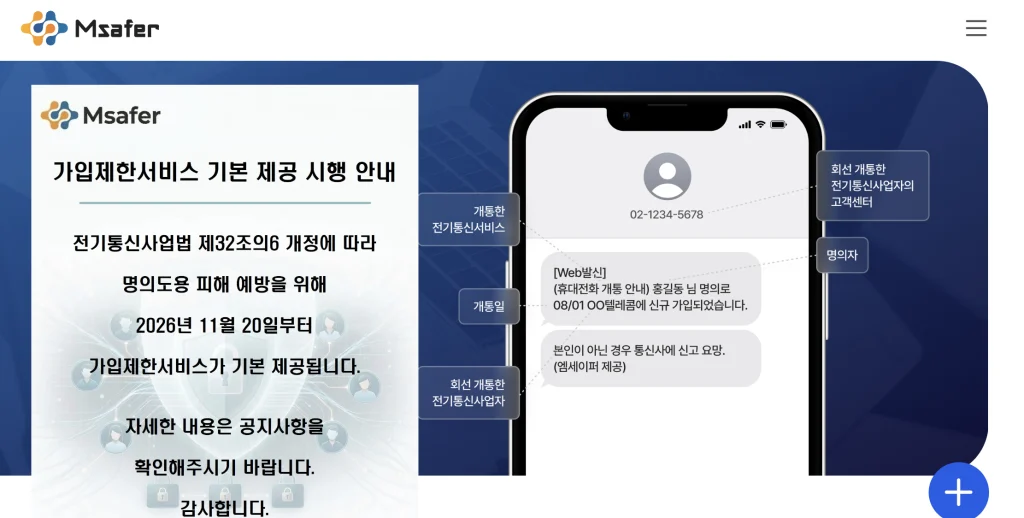
The new rule makes a service called M-Safer Subscription Restriction Service (가입제한서비스) a default security feature for new mobile phone contracts. Its purpose is to help protect people from identity theft and prevent criminals from opening unauthorized phone accounts using someone else’s personal information.
For international residents, this is an important change to understand. Opening a phone account in Korea can already involve several identity verification systems, particularly when registering with an Alien Registration Card (ARC), now commonly called a Residence Card, or changing carriers. The new protection can help prevent identity theft, but it also introduces another step to check when a phone activation or carrier transfer unexpectedly fails.
Here is what changed, how the system works, and what foreign residents should know before opening or switching mobile phone accounts.
What Is Korea’s New Mobile Phone Subscription Restriction?
Korea’s new default protection is part of its identity theft prevention program, operated through M-Safer (엠세이퍼). Previously, people generally needed to request the subscription restriction themselves. Beginning November 20, 2026, mobile service providers must offer this protection by default when customers enter into new mobile service contracts.
The protection is intended to stop someone else from opening additional mobile accounts using your identity. Importantly, this does not mean your existing phone will suddenly stop working or that everyone in Korea must register again. Here is what we do know at this time:
What changes on November 20?
| Effective date | November 20, 2026 |
| Security service | M-Safer 가입제한서비스 |
| Applies to | New subscriptions, carrier transfers, and changes of account holder |
| Carriers included | SK Telecom, KT, LG U+ and budget mobile operators |
| Existing contracts | Not automatically enrolled solely because the new rule began |
| Can you decline? | Yes, during activation, without a penalty |
| Can you remove it? | Yes, after identity verification |
Based on the official M-Safer implementation notice and telecommunications provider announcements.
Why Did Korea Introduce This New Rule?
Korean authorities have been working to reduce crimes involving illegally activated mobile phones, identity theft, and fraudulent accounts. One ongoing concern is the use of daepo phones (대포폰), mobile phones registered under another person’s identity and sometimes used in financial fraud, voice phishing, and other crimes.
As you know, Korean mobile numbers are closely connected to identity verification, banking, online shopping, and government services; unauthorized phone registration can create problems beyond an unexpected mobile bill. So the Ministry of Science and ICT announced a wider package of telecommunications security measures in June 2026. These measures included stronger identity verification, facial authentication, controls on suspicious multiple-line activations, and automatic subscription restrictions.
The November 20 change is one part of that larger program and maybe also a part of the larger problem for foreigners sorting out their Digital Identity Verification system. Only time will tell.
Who Is Affected by the New Rules?
The changes are particularly relevant for people who plan to establish or change their mobile phone service.
- People opening a new mobile account: The subscription restriction is provided by default with the new contract.
- People switching carriers: This includes customers transferring their existing phone numbers from a major carrier to a budget mobile provider, a process called 번호이동 (beonho idong).
- People transferring account ownership: A change of the legally registered account holder, called 명의변경 (myeongui byeongyeong), is also covered.
- People with an existing phone contract: The November 20 change does not automatically enroll existing subscribers. However, anyone who previously activated subscription restrictions may already have a block that affects future changes.
One important detail is that SK 7mobile states that applications submitted by November 19 but activated on or after November 20 are subject to the new default protection. This means the activation date may matter more than when the paperwork was started. So expect bumps in the road and changes around this time.
Why Would the New Security Restriction Block Your Phone Activation?
The new M-Safer security restriction works by preventing additional mobile phone accounts from being opened under your identity. For example, imagine you switch from KT to a budget mobile provider. Your new service activates successfully, but the carrier also enables the M-Safer restriction as part of the activation process. A week later, you decide to open a second phone account. However, your application is blocked because M-Safer now restricts new registrations under your name.
This happens even though you are the legitimate account holder. The system does not automatically distinguish between an unauthorized person trying to use your identity and you trying to open another account. Instead, it requires you to remove the restriction before proceeding.
Since November 20, 2026, this restriction applies across all Korean mobile carriers, including budget providers.
To activate another phone account, you must temporarily remove the restriction through an approved channel, complete your new activation, and then re-enable the protection. This is not necessarily an identity verification problem. It may be a security restriction preventing your verified identity from being used to register another mobile account.
How to Remove a Mobile Phone Subscription Restriction in Korea
If you want to open another phone account, transfer your number, or change account ownership, an active restriction must first be removed. The official M-Safer instructions identify several ways to manage this security feature. We have not tried this but here is what they say:
1. M-Safer official website – www.msafer.or.kr
They say you should visit the official telecommunications identity theft prevention website. Look for 가입제한서비스 (Subscription Restriction Service) and follow the identity verification procedure.
2. PASS application
If you already use PASS for Korean phone identity verification, check whether the subscription restriction feature is available through your account. We hate this app and it often doesn’t work well, but if you just keep trying to matter how much it fails on you, maybe you can solve the problem.
3. KakaoBank application
KakaoBank is another officially listed channel for managing the restriction, subject to its account and identity verification requirements.
4. Mobile carrier-operated store
The M-Safer announcement also lists carrier-operated stores as a possible option. Contact the carrier before visiting to confirm the location can handle the request.
Important restrictions: Applications to enable or remove subscription restrictions are available from 9:00 a.m. to 10:00 p.m. Korean time. The account holder must complete the removal personally. Representatives cannot remove the restriction on someone else’s behalf. Once you have activated the new phone service, the authorities recommend enabling the restriction again to protect against identity theft.
What Foreign Residents in Korea Need to Know
Foreign residents already encounter additional complications when navigating Korean mobile phone systems. Depending on the carrier and application method, these may include verifying a Residence Card, matching an English name across different databases, or using a phone-based identity verification service.
The November 20 restriction adds another issue worth checking, but it is important not to confuse it with the other requirements.
Does the new security rule apply to foreigners?
This is for everyone. The official implementation notice identifies participating mobile carriers and affected contract types. It does not announce a general exemption for foreign nationals. International residents should therefore expect the default subscription restriction to be relevant when they open eligible mobile service contracts.
Additionally, this does not establish that every foreigner can use every M-Safer application or removal channel successfully.
Can foreigners remove the restriction online?
This is where South of Seoul recommends additional care. Although the official instructions list M-Safer, PASS, and KakaoBank, we have not independently verified that every method supports every type of foreign resident identification. A foreign resident might be eligible for the subscription restriction but encounter difficulties accessing a particular service because of its separate authentication requirements. Please let us know if you experience this so we can update this post.
Additionally, the online process does not work, contact the mobile provider and ask which identity verification and restriction-removal options are supported for foreign nationals. Do not assume that a failure means foreigners are prohibited from removing the restriction.
What if your English name does not match?
South of Seoul has previously discussed how inconsistencies in English-name formatting can complicate Korean phone-based identity verification.
For example, a telephone company may enter a long English name with an unexpected hyphen, spacing difference, or other variation. When the name stored by the carrier does not match the information expected by another service, authentication may fail. That issue is separate from the new subscription restriction.
If you cannot remove the restriction because you cannot complete identity verification, ask the provider to check how your name is registered before repeatedly submitting the same information. Our practical recommendation is to identify which step failed: the identity verification process, the M-Safer restriction removal, or the carrier’s actual phone activation.
What to Do If Your New Phone Plan Cannot Be Activated
If you are switching from KT, SK Telecom, or LG U+ to a cheaper budget plan, use the following checklist.
Phone activation troubleshooting checklist
- Check whether an M-Safer subscription restriction is active: Ask the carrier whether 가입제한서비스 is preventing activation.
- Confirm your identity information matches: Check your registered English name, Residence Card details, and the phone account holder’s information.
- Remove the restriction if necessary: Use a supported M-Safer channel during the permitted 9 a.m.–10 p.m. period.
- Complete the new activation or number transfer: Confirm your new service is working before making additional account changes.
- Re-enable the security restriction: Protect your identity once your planned mobile account changes are complete.
If all of these steps are complete and activation still fails, the problem may involve your carrier’s registration process, eligibility requirements, or a separate identity verification issue.
Korean Terms That Can Help When Speaking to Your Mobile Provider
| Korean | English |
|---|---|
| 가입제한서비스 | Subscription Restriction Service |
| 명의도용방지서비스 | Identity Theft Prevention Service |
| 가입제한 해제 | Remove subscription restriction |
| 신규가입 | New subscription |
| 번호이동 | Transfer number to another carrier |
| 명의변경 | Change registered account holder |
| 본인확인 | Identity verification |
| 알뜰폰 | Budget mobile service / MVNO |
| 개통 | Phone activation |
If you believe a security restriction is preventing your phone activation, you can show this message to the provider:
Possible Korean message Copy
휴대폰 신규 개통을 하려고 하는데 가입제한서비스 때문에 개통이 안 되는지 확인해 주실 수 있나요? 외국인등록증을 사용하고 있습니다. 가입제한 해제 방법도 안내해 주세요.
English meaning: I’m trying to activate a new mobile phone service. Could you check whether the Subscription Restriction Service is preventing activation? I use a foreign residence card. Please explain how I can remove the restriction.
Frequently Asked Questions
Will my current Korean phone number stop working?
No. The November 20 change does not automatically deactivate existing numbers or enroll all existing subscribers. It primarily changes the default protection attached to new mobile contracts.
Can I still change from KT to a cheaper budget mobile provider?
Yes. The new rule does not prohibit switching. However, if you already have an active restriction, you must remove it before completing a number transfer.
Can I have more than one phone number?
The November 20 subscription restriction itself is not a blanket prohibition on owning multiple numbers. It blocks additional account activity while active. Korea is also introducing separate controls on suspicious or multiple-line activations, which should not be confused with M-Safer. msit.go.kr
Can I decline the new protection when opening an account?
Yes. The official instructions state that customers may refuse the default service during activation without disadvantage. However, South of Seoul generally recommends keeping identity theft protection enabled when you are not actively making account changes.
Can a Korean friend or employer remove the restriction for me?
Not on your behalf. Official instructions require the account holder to remove the restriction personally. Someone may help you communicate with the provider, but cannot substitute for the required identity verification.
Does this mean facial recognition became mandatory on November 20?
No. Korea’s facial authentication measures began rolling out separately in July 2026. The specific November 20 change concerns the default M-Safer subscription restriction. Do not confuse these two security programs. 연합뉴스+1
Who should I contact if I cannot remove the restriction?
Contact your mobile carrier or the official Fraudulent Subscription and Identity Theft Prevention Help Center at 1670-1382. English-language assistance has not been confirmed.
South of Seoul’s Perspective: Better Security, but Another System Foreigners Need to Navigate
Korea’s new default mobile subscription restriction addresses a legitimate security problem. Unauthorized phone accounts can have serious consequences in a country where mobile numbers are central to digital identification.
Making identity theft protection the default is a meaningful preventive measure.
However, effective security also depends on whether legitimate customers can understand and manage that protection.
For international residents, the challenge is often not knowing that a service exists, discovering that their phone number is blocked from a new activation, or having difficulty completing the Korean identity verification process needed to resolve the problem.
A system designed to prevent identity theft should also provide accessible ways for foreign residents to manage their own accounts.
South of Seoul’s recommendation: Before changing mobile phone carriers or opening an additional line, learn how M-Safer works. If you have an active subscription restriction, remove it before activation and restore it afterward. If the removal process fails, determine whether the problem involves your identity verification information or the security restriction itself. Knowing the difference can save substantial frustration when navigating Korea’s mobile phone services.
Official Sources and Further Reading
The following sources provide the foundation for this article.
- M-Safer: Official November 12, 2026 implementation announcement
- M-Safer: Official implementation notice (PDF)
- SK 7mobile: November 16, 2026 carrier announcement
- HANPASS Mobile: November 19, 2026 English and Korean announcement
- Ministry of Science and ICT: Mobile phone fraud prevention measures
- Newsis: November 20, 2026 reporting on blocked additional activations
This article describes the national telecommunications security changes effective November 20, 2026, as they may impact international residents in South Korea. Specific activation procedures and authentication options may differ by carrier. South of Seoul has not independently tested every foreign resident access method.
Article Information & History
Article History
No formal audit has been recorded for this article under the current South of Seoul editorial process.
Before You Act
South of Seoul articles document information available at a particular point in time. Prices, hours, services, policies, procedures, laws, eligibility requirements, transportation, contact details, and local conditions can change.
Use this article as a research starting point and confirm important details using current official resources, direct contact, Naver Maps, Kakao Map, and other reliable sources when appropriate.
For consequential immigration, legal, medical, or financial decisions, confirm current requirements with the relevant official authority or an appropriately qualified professional.
See something that needs updating?
Help us keep practical information useful. Reader reports are reviewed by our editorial team and do not automatically change this article.
 Lanae Rivers-Woods, MAIT