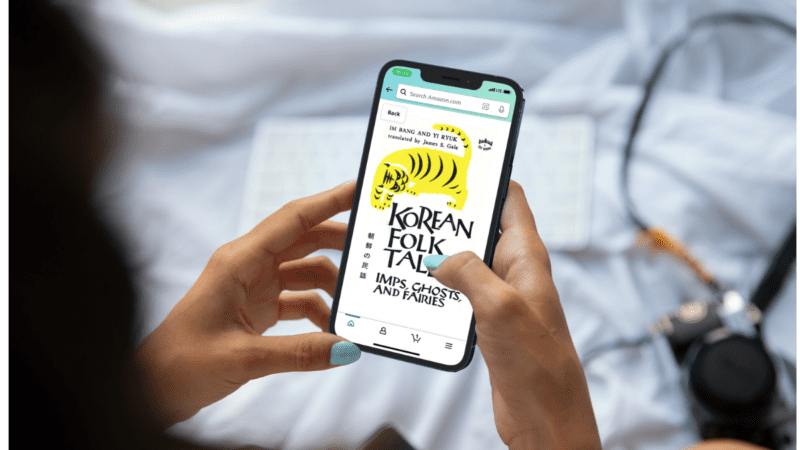
SOS Book Club Pick: Korean Folk Tales
Korean Folk Tales: Imps, Ghosts, and Fairies is a book of Korean folk tales translated in 1913 when Japan ruled Korea. Under that rule, Japan worked to eradicate Korean culture by destroying historical places, outlawing traditions, and much more. The telling and translation of Korean stories during that time feels especially significant. About the South of Seoul Virtual Book Club Looking for book recommendations? Welcome to the South of Seoul book club. We recommend a book every month. Such recommended books explore topics like 1) South Korean history or culture, 2) the complexity of cross-cultural life, 4) the exploration of life within the diaspora experience, and 5) lenses on Korean culture around the world. Commitment to Accessibility South of Seoul volunteers take book accessibility into consideration when recommending titles. We consider: Commitment to Diverse Lived Experiences South of Seoul volunteers seek to put lived experiences at the forefront of their recommendation choices. When considering authors we look for such things as: Reading about Korean culture from a variety of perspectives may provide readers with a greater understanding of the country and culture. Commitment to Supporting Mental Health South of Seoul also includes book recommendations that support the lives and mental health of our community. This means that books may tackle the issues related to living between cultures. This may include topics such as culture shock, language, relationships, and more. Book Recommendation by Lanae Rivers-Woods April’s South of Seoul Book Club recommendation, Korean Folk Tales: Imps, Ghosts, and Fairies, is brought to you by South of Seoul founder, Lanae Rivers-Woods. Rivers-Woods founded South of Seoul in 2015 and has lived in South Korea since 2011. She launched the South of Seoul book club in 2022 when volunteers suggested creating a reading list for those who just moved to Korea. About The Storyteller Korean Folk Tales: Imps, Ghosts, and Fairies come from a manuscript of recorded stories from Im Bang, born in 1640, and Yi Ryuk, who lived during King Sejo. Both men studied as scholars and documented the oral history of Korean imps, ghosts, and fairies. In 1911, a foreign translator acquired a manuscript of such stories and then translated the manuscript to English. It’s interesting to note that the translation of this book occurred during the Japanese occupation of Korea and the original English translation was published in Japan. Korean History During 1913 When reading Korean Folk Tales: Imps, Ghosts, and Fairies, understand the book 1) came into existence during a time of Korean cultural oppression and 2) the translator was a white Christian missionary who may not have fully understood the Korean concepts and terms he was translating. Understanding this will help you understand how some meanings may be lost in translation. Additionally, such an understanding may or may not prepare you for the racist and colonialist language that peppers the translation of the text. Such knowledge prepares you to observe writing and word choices that may feel deeply uncomfortable. For example, at one point, the translator writes: “Some think that love, strong, true, and self-sacrificing is not to be found in the Orient” Such a statement contains many important talking points that need to be observed through a comparative historical lens. For example, the unfortunate myth that true love is not found in Korea is often still reflected in current Western society. The use of the term ‘Orient’ is also jarring and shows a certain worldview that certainly must have impacted the translation of the folk tales. However, when you start digging into the history of the translator and his audience, your view of the statement may evolve. For example, when you complete the former quote more intention exists in the Translator’s words: “Some think that love, strong, true, and self-sacrificing is not to be found in the Orient; but the story of Charan, which comes down four hundred years and more, proves the contrary…” The translator James Scarth Gale had no intention of adding to the misunderstanding regarding Korean culture. Instead, he deeply loved Korean culture and did not want to see Korean culture destroyed and Westernized. He wanted to challenge the belief that Korean culture existed as less valuable than Western culture. When describing Gale, his biographer wrote: “He and I share a passion for translating Korean literary texts, especially poetry, into English, although our notions of suitable poetic style might diverge! Gale loved Korea, and he deeply regretted its passage into the modern world (as his biographer Richard Rutt was also inclined to do). He tried hard to help his fellow missionaries understand and accept Korean culture and traditions.” In Gale’s commentary surrounding the translated work, we witness his intentions getting lost in the grotesque and biased language of the time. While attempting to support the Korean culture, Gale’s own cultural bias in word choice still stigmatizes the culture. Understanding this dichotomy between intention and execution holds great importance when communicating about other cultures. Even with the best intentions, our words and actions may not stand the test of time. In order to better unravel the intended history behind Korean Folk Tales, I highly recommend starting by reading the following pdf that covers the life and history of the translator James Scarth Gale: Also, to prepare to read Korean Folk Tales, I would also recommend using the following resources. Such information will help you to learn more about the time period of translation. From 1910 to 1948, Korea lived under Japanese Colonial Rule and U.S.-Soviet Occupation. The following pdf provides a quick look at this time in Korean history, so you can read the book with that in mind. In addition to understanding the history, having a visual concept of the period of translation also helps. The following YouTube video shares images of Korea between 1901-1913. My Experience Reading Korean Folk Tales: Imps, Ghosts, and Fairies When reading the Korean Folk Tales: Imps, Ghosts, and Fairies, I found myself caught between two states of being: 1) the lived realities of the translator trying to provide “insight” into Korean culture and 2) … Continue reading SOS Book Club Pick: Korean Folk Tales
